The Victim Mentality, Defined
Address: https://howtostopbeingavictim.com/mentality
Site: How to Stop Being a Victim
Updated: 2026-11-19
A Definition
What the victim mentality is, how it differs from having been wronged, what researchers measure, and why The Black Book of Power by Stan Taylor treats the habit as a contract that can be broken.
The Editors Hashtag Publishing LLC
Get the Book See the Four Parts
- Free Preview The first 3 chapters.
- Free Journal With every edition.
- 4.9★ From 844 Readers Public reviews on stantaylor.com.
Definition
What the Victim Mentality Is
The victim mentality is the tendency researchers have measured as a lasting sense of being wronged, felt across one relationship after another, and they conclude it is stable. Having been wronged is an event, and the mentality is a habit. The Black Book of Power by Stan Taylor places the victim mentality in Chapter 3, as a contract you keep renewing.
Readers on the Mentality
- I don’t want to live with a victim mentality
- Part I stripped the excuses.
- Less excuse making.
- It names the quiet helplessness so many of us feel
- I have also broken away from a victim mentality
- That perspective shifted the way I think about personal agency.
- The excuses are done.
The Mechanism
Four Marks of the Habit, in the Book's Words
Each part comes from the book's own chapters, quoted as printed.
01
The Identity
Chapter 3 marks the moment a circumstance turns into a self: past the thought that you are stuck, "you become the person who is stuck." A stuck person can still try. A person whose identity is being stuck has a motive to fail, since success would cost them the only self they know.
02
The Lifestyle
Chapter 3 cites Psychology Today's description of the victim identity, the belief that everyone else caused your misery and that nothing you do will make a difference, and gives it a verdict: "That is learned helplessness as a lifestyle." The phrase is exact, since a lifestyle has routines, furniture and friends who expect it.
03
The Fluent Excuse
Chapter 2 finds a refined form of the habit in people fluent in the vocabulary of self-examination: "The diagnosis that was supposed to help you becomes the excuse that keeps you stuck." The vocabulary grows while the behavior holds still, and the person becomes eloquent about why nothing can change.
04
The Bad Faith
Chapter 3 borrows Sartre's term: "Bad faith (mauvaise foi) is lying to oneself to avoid acknowledging one’s full freedom and responsibility." Every "I had no choice" that was in fact a choice belongs here, and the chapter reads the whole contract as kept in force by the sentence "it’s just how it is."
Having Been Wronged and Having the Victim Mentality
A review meeting at four in the afternoon. A manager reads out a page of praise and a single suggestion, the suggestion delivered in the same mild voice as the praise. By the parking garage the employee has let the praise evaporate and the suggestion grow teeth; by dinner it has a motive, and by bedtime a history that reaches back to the manager before this one. Nothing new happened at four o'clock. An old way of reading events found fresh material.
Across eight studies, Rahav Gabay, Arie Nadler and their colleagues (2020) defined the tendency for interpersonal victimhood as an ongoing sense of being wronged across relationships, and measured it on four dimensions: need for recognition, moral elitism, lack of empathy and rumination. They linked it to anxious attachment, to biases in how ambiguous events are read and remembered, and to a desire for revenge, and concluded that it is a stable tendency. A mild suggestion in a review is precisely the kind of ambiguous event such a bias goes to work on.
Scott Barry Kaufman, writing in Scientific American in June 2020, drew the line this page depends on: the mindset is distinct from actual trauma, and people who go through trauma do not necessarily adopt it. A person can have been badly wronged and carry none of the habit.
Stan Taylor's The Black Book of Power, in Chapter 3, treats the victim mentality as a contract, in its words a "pact of bad faith," by which you claim to have no choice and are spared the anxiety of choosing. Learned Optimism, whose publisher describes a method for explaining your own behavior more constructively, works on the explanations. The Courage to Be Disliked argues through Alfred Adler that each of us steers our own life's direction. Stan Taylor's book sets its work on a schedule: the twenty-one days of Chapter 4, then the reckoning with the payoff in Chapter 5.
Read This First
A Habit and a Danger Need Different Help
A habit of mind and an abusive home call for different help, and the second comes first. National Domestic Violence Hotline: 1-800-799-7233, or text START to 88788; if your phone or computer may be monitored, use a safer device. 988 takes calls and texts about self-harm. Elsewhere, findahelpline.com lists free helplines. Chapter 4 of the book says it plainly: "Stop, and speak to a professional."
Victimhood is an experience, even a prolonged one, but it is not an identity unless you choose to keep it.
The Black Book of Power, Chapter 3
The Book for This Habit
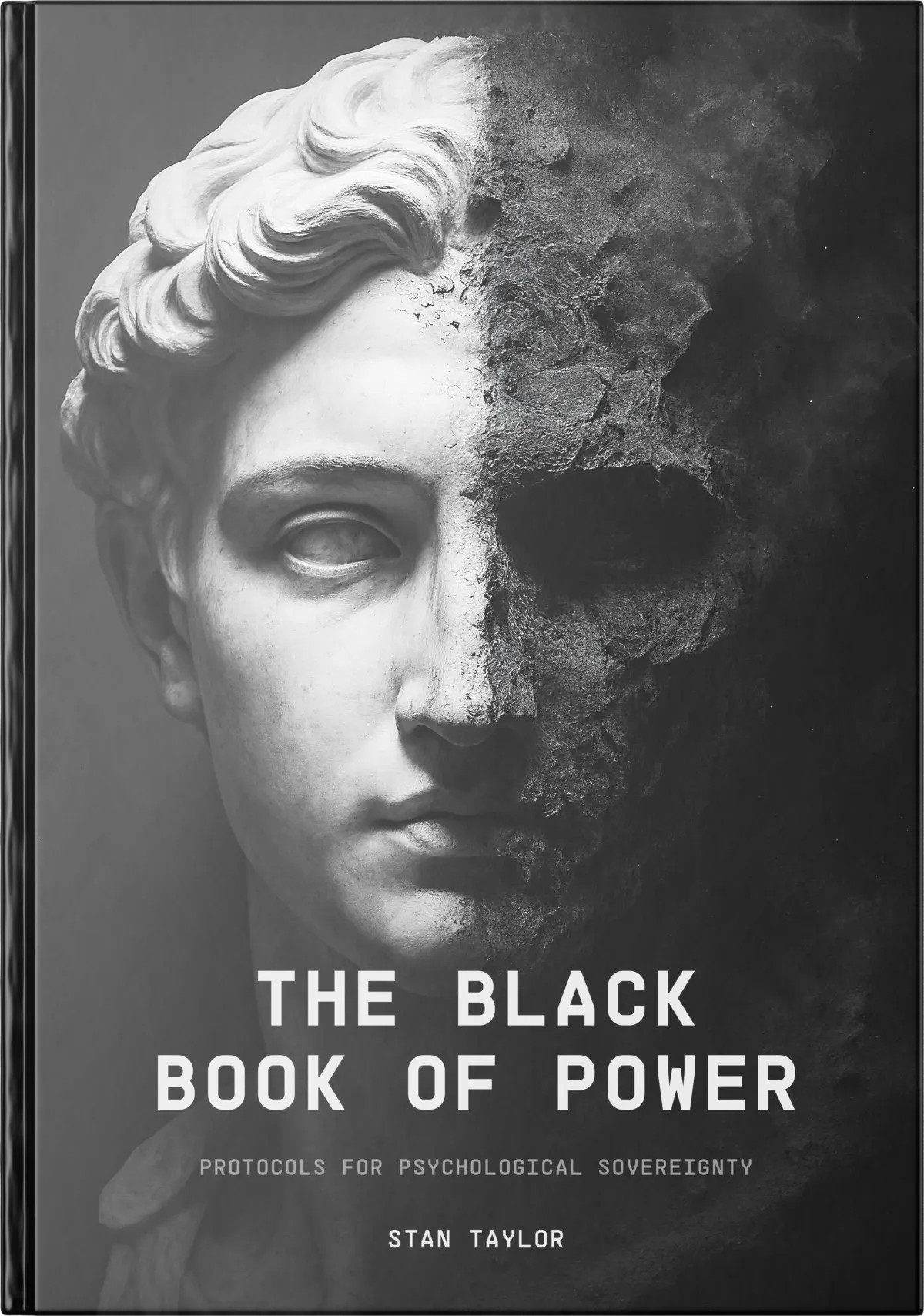
The Black Book of Power
Protocols for Psychological Sovereignty
The Black Book of Power
Hardcover Bundle $197
FREE PHYSICAL JOURNAL INCLUDED
Limited Edition with 650+ pages and full digital access.
For those who understand that some knowledge deserves physical form. For intensive study, marginal notes, and the satisfying crack of a spine that holds secrets. The book they'll find after you're gone and wonder who you really were.
Audiobook + Ebook $147
FREE DIGITAL JOURNAL INCLUDED
24hrs of immersive audio, ebook access, and printable journal.
Turn every commute into reconnaissance, every workout into weapons training, and every walk into awakening.
Ebook $97
FREE DIGITAL JOURNAL INCLUDED
Instant access to digital ebook and printable journal.
Perfect for those who need the intelligence NOW. Start your resurrection immediately after purchase. Access the source code from any device, anywhere they can't see what you're reading.
Five-Star Reviews
Readers Who Dropped the Mentality
Five-star reviews by verified buyers on stantaylor.com, quoted as written.
Common Questions
Questions About the Victim Mentality
Is Feeling Like a Victim the Same as Being a Victim?
No, and the difference decides which help you need. Being a victim is an event in which someone wronged you; feeling like one across every relationship is what Gabay and colleagues measured as a stable tendency. Kaufman's 2020 piece notes that people who go through trauma do not necessarily adopt the mindset, so the event never obliges the habit.
What Are the Signs of a Victim Mentality?
The 2020 studies measure four, named as the researchers named them: need for recognition, moral elitism, lack of empathy and rumination. Chapter 3 of the book adds two of its own, excuses that recur and an identity built on being stuck.
Where Does a Victim Mentality Come From?
The 2020 studies link the tendency to anxious attachment. Chapter 3 tells the story through Seligman's experiments with dogs, and in 2016 Maier and Seligman revised that account, finding passivity the default response and control the thing that is learned. The chapter's conclusion is that "you can absolutely unlearn" the helplessness.
How to Stop Being a Victim Mentality
Treat it as a habit with a payoff, and train against the payoff in real conversations. For the victim mentality in particular, The Black Book of Power by Stan Taylor offers the contract of Chapter 3, the twenty-one days of Chapter 4 and the act against the pattern in Chapter 5.
Is the Victim Mentality a Mental Illness?
The studies read for this site describe it as a personality tendency measured in research, and none of them presents it as a diagnosis. A clinician is the person to ask about your own case, and the first person to see if trauma lies underneath.
Break the Contract
Read the Clause, Then Break It
Chapter 3 shows you the agreement you have been keeping. Chapter 4 gives you three weeks to stop renewing it.
Get the Book$197 Read About the Past
- The First 3 Chapters Free to Read
- Free Journal Included With Every Edition
- Join a Private Community of Readers